
Artificial Intelligence (AI) companies are making vast claims about their tools replacing human labour. Some jobs will be automated, others will be "augmented." The bosses of the world's biggest companies are diverting vast sums into these tools, partly with the knowledge that they could save money on headcount.
"Flat is the new up," we are told, in terms of the size of a company's workforce as investors ask whether jobs should be done by new recruits—or, instead, armies of "AI Agents," virtual workers tasked with doing specific roles, some of them relatively skilled.
If even half true, there will be an impact on us all, across sectors and individual careers, and perhaps it will happen sooner than we think.
Nobel prize-winning economists recently warned the world “must act now” to ensure that AI leads to rising living standards and not large-scale job displacement. London businesses have warned they are struggling to find the skills they need as AI disrupts the jobs market.
What the Data Shows
It is early days yet, but there are already some notable patterns in the data.
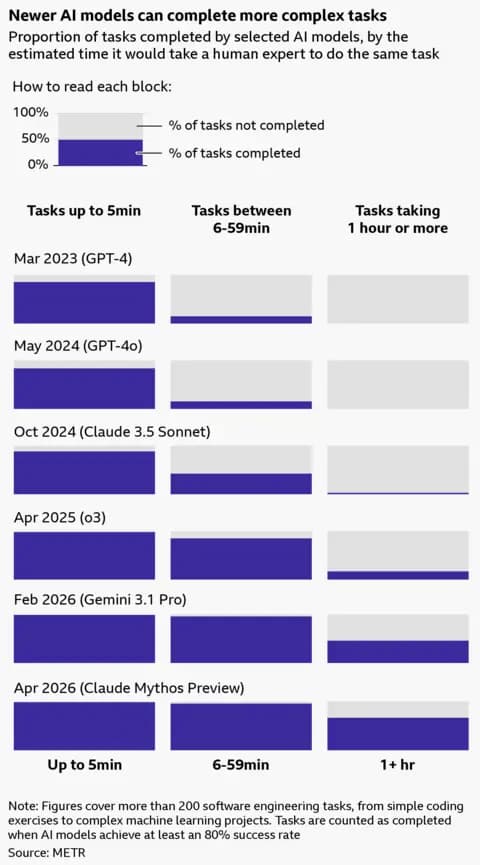
This chart is the industry benchmark for how various models can perform tasks previously done by humans, in this case using and developing computer software. Three years ago, large language models (LLMs) were only able to reliably complete tasks humans took seconds or minutes to do. Now they are increasingly able to complete fairly complex tasks taking an hour or so.
The latest generation of models could start to entirely develop themselves in the next year or so. This pattern is also being seen, at an earlier stage, with financial analysis, early stage legal work, and even some entry-level creative industry jobs.
Impact on Employment
Stanford University's analysis of wage and jobs data finds a hit to employment for 22 to 25-year-olds of 2.7% since ChatGPT became widespread, rising to 12.8% in the most AI-exposed sectors such as finance, software, and creative industries.
Online job postings have also been affected since the launch of ChatGPT and other LLMs. The UK was hit quite notably on this measure, and on most international measures, the UK's service sector concentration leaves it exposed to potential AI job losses.
The Token Economy
AI usage is measured in "tokens"—small chunks of text that AI systems use to understand, analyse, and generate language. There have been astonishing increases in AI use in 2026, and the increase in token use has vastly outweighed the declining “per token cost.”
Trillions of tokens have been used over the past few months primarily for “agentic use”—agents that can perform tasks automatically. However, incredible bills were racked up, so much so that many companies have now begun to ration the use of these models.
Limits to Automation
This might show that there are limits to how much work could be automated. The virtual workers might be more expensive than the human ones, depending on the task. However, many companies are diverting to much cheaper forms of AI derived from Chinese models.
So there is much uncertainty, but some clear trends are emerging.
- #ai
- #jobdisplacement
- #automation
- #futureofwork
- #careerimpact
Comments · 0