Canada's Job Market Rebounds in July: Key Insights on Employment, Earnings, and Vacancy Trends
Employment Rebounds with Modest Growth
New data from Statistics Canada shows a rebound in payroll employment for July, with an increase of 21,600 jobs (+0.1%), following a slight decline in June. However, overall employment has seen little net change since January, remaining 15,500 jobs below the start of the year.

Average weekly earnings reached $1,307.86 in July, up 3.3% from a year earlier, with a month-over-month increase of 0.6%. The average workweek held steady at 33.3 hours, though this was 0.6% lower than in July 2024.
Employment by Sector
Six out of 20 sectors experienced payroll employment gains in July. The largest increases were in health care and social assistance (+14,900; +0.6%), finance and insurance (+8,700; +1.0%), and accommodation and food services (+2,600; +0.2%).
In contrast, some sectors faced declines. Manufacturing lost 4,600 jobs (-0.3%) in July, contributing to a cumulative decline of 28,000 (-1.8%) since January. Most subsectors, including transportation equipment, machinery, and chemical manufacturing, reported losses, according to Statistics Canada.
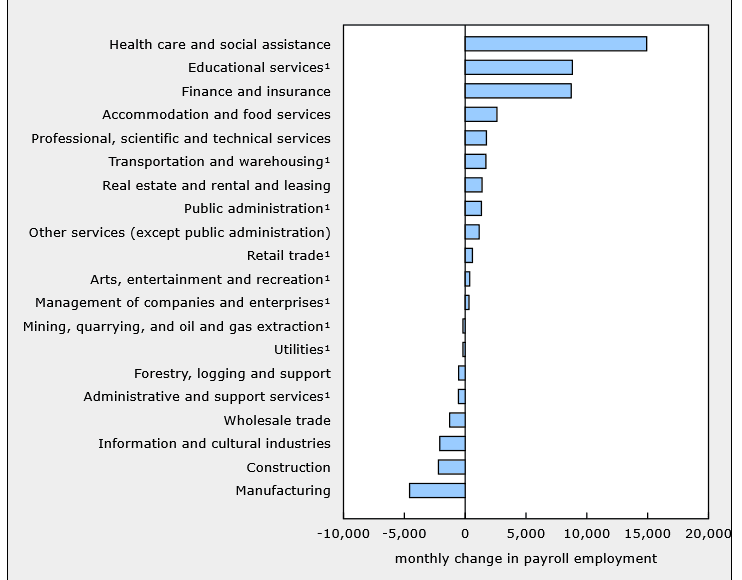
Construction employment fell for the second consecutive month, down by 2,200 jobs (-0.2%). Since peaking in December 2024, the sector has shed 13,700 jobs (-1.1%), with specialty trade contractors and residential building construction seeing the largest drops.
Job Vacancies Drop
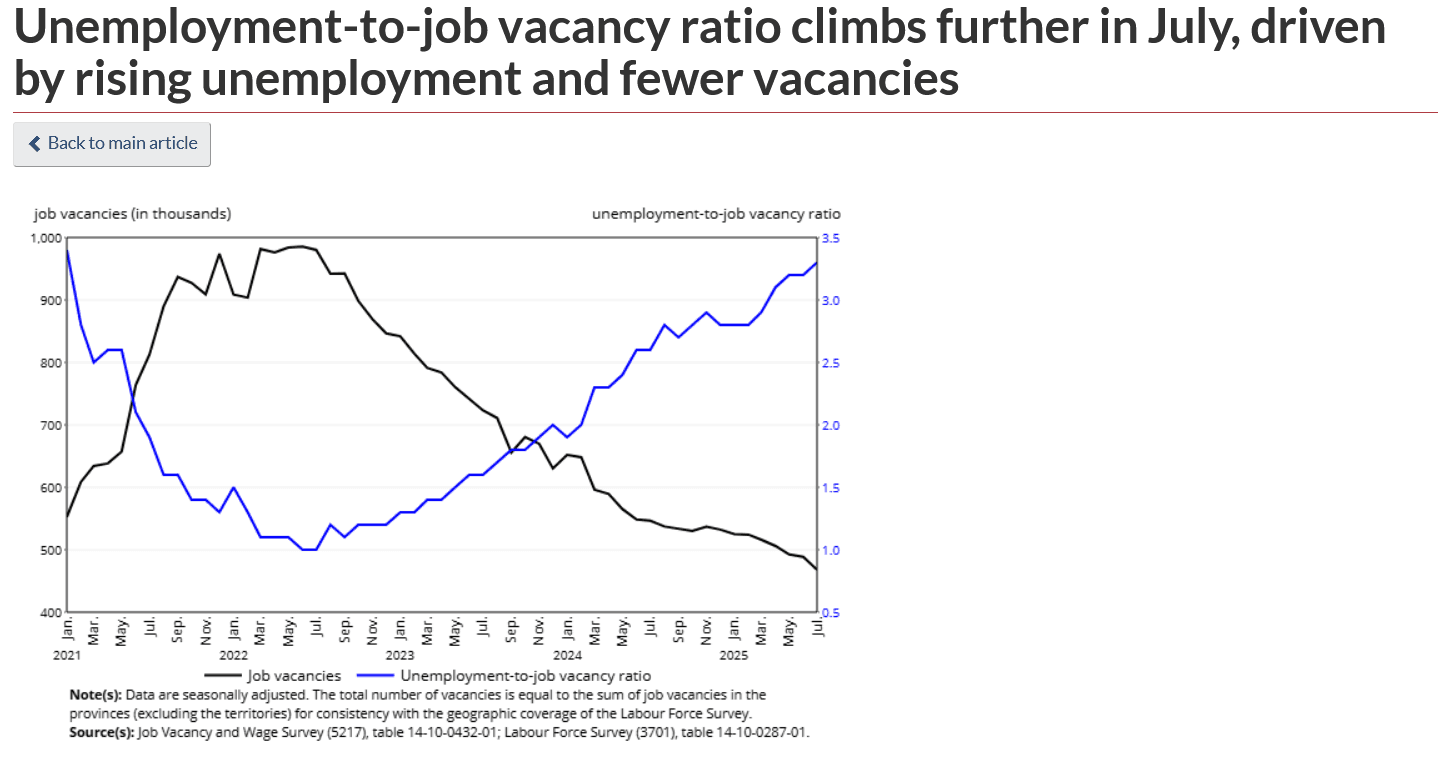
Job vacancies dropped by 20,600 (-4.2%) to 469,900 in July. Compared to last year, vacancies are down by 79,400 (-14.5%). The job vacancy rate decreased to 2.6%, down from 2.7% in June and 3.1% in July 2024.
There were 3.3 unemployed persons for every job vacancy in July, up from 3.2 in June. Statistics Canada notes that this is the highest unemployment-to-job vacancy ratio since January 2017, excluding the COVID-19 pandemic years of 2020 and 2021.
Job vacancies fell most sharply in construction (-5,600; -14.3%), finance and insurance (-4,100; -19.4%), and agriculture, forestry, fishing and hunting (-1,700; -24.4%). Health care and social assistance saw the largest year-over-year drop in vacancies (-32,800; -26.1%).
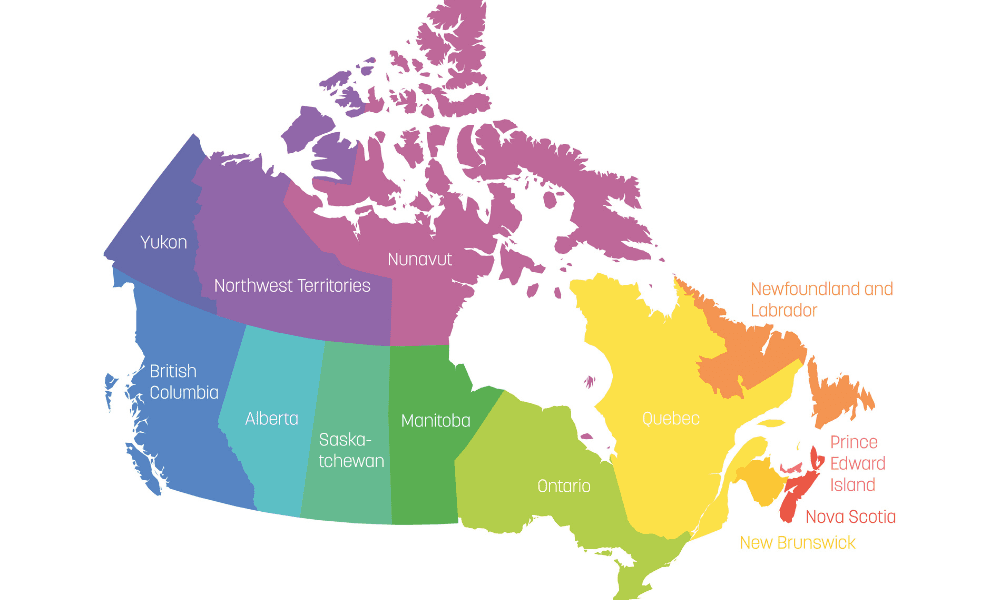
Among provinces, Alberta (-6,100; -8.9%), Quebec (-5,300; -4.9%), and Newfoundland and Labrador (-1,300; -26.9%) recorded the biggest decreases in job vacancies. Nova Scotia (3.2%), British Columbia (3.0%), and Alberta (2.9%) had the highest job vacancy rates, while Newfoundland and Labrador (1.6%), Ontario (2.4%), and Quebec (2.6%) had the lowest.
- #employment
- #jobvacancies
- #earnings
- #sectortrends
- #statistics
Comments · 0